The DIY Guide to Growing Your Tour Business Online
A step-by-step playbook built around the Resmark Growth Engine — the same framework used to grow a $15M+ tour company and hundreds of operators like yours.
When following this framework, here's what operators are achieving
400%+
ROAS Achieved
32%+
Conversion Rate Increase
40%+
Sales from SEO Strategy
Welcome
This guide was built for operators who are serious about growth.
If you're running an established outdoor adventure business — rafting, hiking, multi-day expeditions, guided tours — and you're ready to stop guessing and start building a system that produces consistent, measurable bookings, you're in the right place.
This guide is built around the Resmark Growth Engine, a framework developed by operators who built and grew a $15M+ tour company, then used those same strategies to help hundreds of other operators do the same.
The Resmark Growth Engine
Five stages. Each with proven strategies. All working together.
A full walkthrough of the framework before we dive into each stage.
Stage 01
Dreaming: How People Discover You
This is all about visibility and first impressions. Before anyone can book with you, they have to find you — often before they even know they want what you offer. If you're not showing up here, nothing else in the Growth Engine matters.
Core Question
Can the right people find you when they're deciding what to do?
3x
More likely to book after seeing a brand across multiple channels
527%
Growth in AI search traffic year over year
5–7
Touchpoints needed before most travelers make a booking decision — so show up everywhere
64%
Of travelers say social media inspires their travel decisions
Dreaming — Internal
AI + Search (Organic)
Organic search is the foundation of your long-term visibility. When someone types "whitewater rafting in Utah" or "best guided hiking tours Grand Canyon" into Google — or increasingly into ChatGPT, Perplexity, or Gemini — you need to show up at the top. Strong SEO powers both traditional search rankings and your AI search presence simultaneously.
What actually moves the needle in 2026:
One strong H1 per page targeting your primary keyword
Meta titles with primary keyword + location + brand name
Schema markup for tours, reviews, and FAQs
Fast-loading, mobile-first design — Google penalizes slow sites
Quality backlinks from tourism boards, travel blogs, and local partners
Helpful, intent-matched blog content and travel guides written for humans, not algorithms
Google Business Profile fully set up, verified, and updated monthly
Case Study
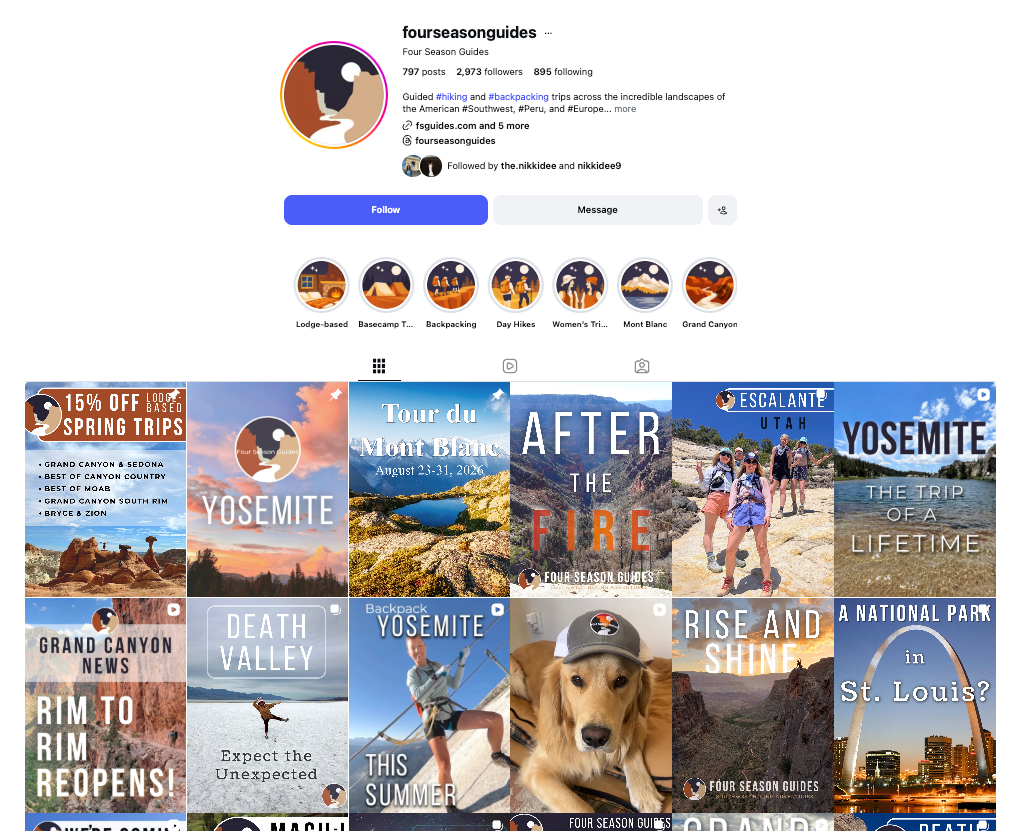
Four Season Guides — How Strong SEO Means Spending Less on Ads
Based in Flagstaff, AZ, Four Season Guides leads hiking and backpacking trips across the Southwest. Their story is a perfect example of what happens when SEO is done right: organic visibility grows, reliance on paid ads shrinks, and revenue goes up — not down. What made the difference wasn't just "doing SEO" — it was committing to a strategy that is constantly growing and evolving. Rankings don't maintain themselves. The operators winning in search are the ones treating SEO as an ongoing investment, not a one-time project.
110%
Increase in organic clicks YoY
34%
Improvement in avg keyword position
35%
Reduction in monthly ad spend
590K
Impressions (up from 149K)
"We cut our monthly ad spend by about 35% and we haven't seen a drop in customer count. In fact, we've seen an increase in revenue." — Dave Logan, Owner
Paid search ads are optimized across Google and AI platforms for high return on ad spend. SEO builds long-term visibility — paid ads fill the gap while you're building it and amplify results once you have it.
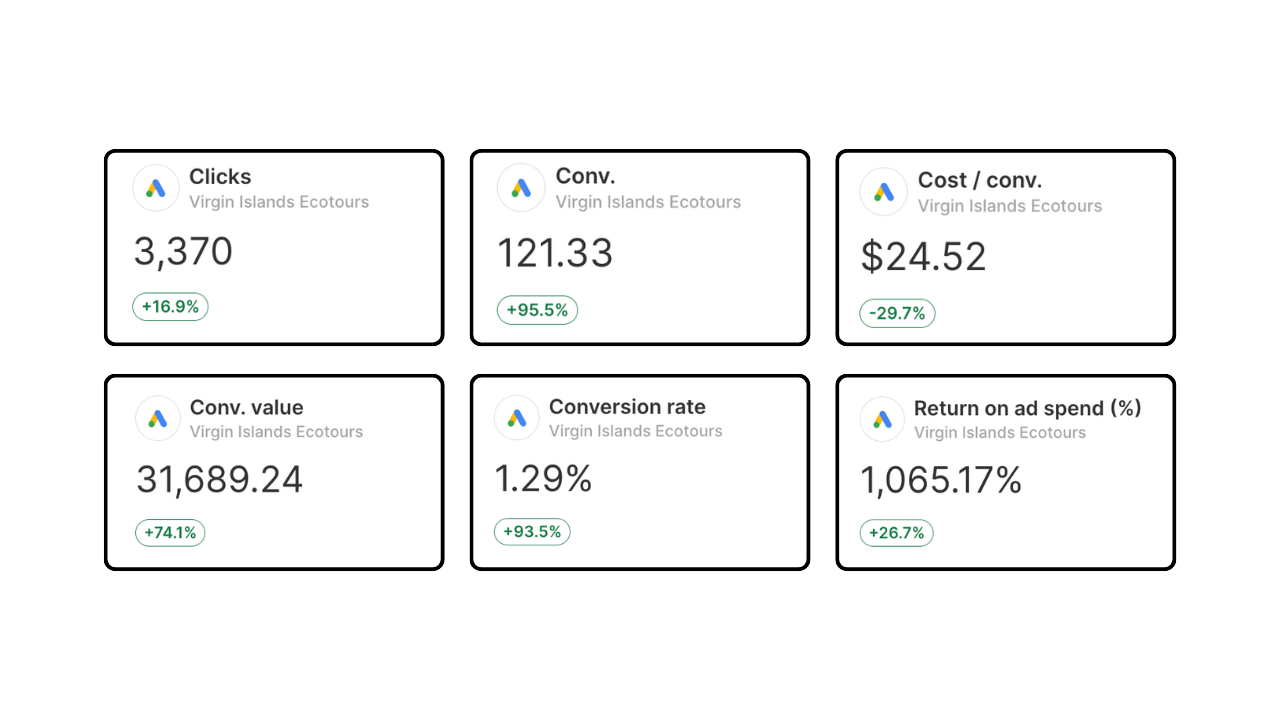
400%+
ROAS achieved for Virgin Island Ecotours — $3K spent, $31K+ tracked in one month
46%
Of all clicks go to the top 3 paid search results
What those numbers mean: ROAS (Return on Ad Spend) shows how many dollars you earned for every dollar spent. Conversions are completed bookings tracked through your ads. CPC (Cost Per Click) is what you pay each time someone clicks your ad. When Google Ads are run effectively with a solid budget and the right strategy, the ROI speaks for itself — but don't just throw money at Google Ads. You need to know what you're doing, and it needs to make sense for your business at this stage of growth.
When paid search makes sense:
Does your website convert?
Fix conversion first. Paid ads send traffic — if your site can't convert it, you're paying to lose people.
Do you have a revenue gap?
If organic is tracking toward $500K and your goal is $1M, paid search bridges that gap fast.
Do you have capacity?
Don't run ads if you can't handle the volume. Overbooking destroys what good marketing builds.
Do you have a nurture system?
96% won't book on the first visit. Without follow-up, most of your ad spend walks out the door.
Did you answer yes to all 4 of these? If so, paid search ads could be a great avenue for your business — one that pays for itself when run the right way.
Your organic social strategy actively reaches and drives traffic from new ideal audiences — at zero media cost. Social media puts your brand in front of people in the exact moment they're dreaming, before they've decided where to go or who to book with.
"I was scrolling and saw these beautiful Iberian lynx in Spain and thought — wait, you can actually go see these on a tour? That was it. I was booking a trip to Spain months later, all because of one social media post."
— Nikki, Marketing Director of ResmarkWeb
What works right now:
Short-form video outperforms everything — even a simple pan of a river can get 1.5M views
Give guides a small incentive ($20–30) to capture and submit content from trips
Paid social ads on Facebook and Instagram allow you to reach cold audiences who match your ideal guest profile — and retarget warm audiences who've already shown interest. Unlike search ads, paid social meets guests while they're scrolling, not searching. The creative does the heavy lifting.
Top of funnel — branding and awareness ads to cold lookalike audiences
Middle of funnel — retargeting people who engaged with your social content
Bottom of funnel — retargeting website visitors and past guests with direct offers
Authentic video and real guest content dramatically outperforms stock imagery
Run a sequence of 3–4 ads — reminder, social proof, urgency — for warm audiences
Start with Facebook Feed and Instagram Stories for best budget efficiency
Video (Organic)
Organic video content on Instagram Reels, TikTok, and YouTube is one of the highest-reach, lowest-cost channels available to tour operators. Viewers retain 95% of a video message vs 10% when reading — and the algorithm actively distributes good video to people who haven't followed you yet.
The first 3 seconds determine everything — hook people immediately or they're gone
Micro-education performs extremely well: "Why river levels change daily," "What to pack for your first raft trip"
Guest reaction videos are nearly impossible to fake and incredibly persuasive
Add captions — most people watch without sound, especially on mobile
One great video can be cut into 5–10 pieces of content across platforms
Video (Paid)
Paid video ads — on YouTube, Facebook, and Instagram — allow you to reach targeted audiences with immersive, story-driven content before they ever search for you.
YouTube pre-roll ads target users watching related travel and outdoor content
Facebook and Instagram video ads in-feed stop the scroll better than static images
Keep paid video ads under 30 seconds — get to the hook fast
Use your best organic video content as paid ads — if it worked organically, amplify it
Referral
Word of mouth is still one of the most powerful booking drivers in the tour industry — and most operators do nothing to systematize it.
Ask for referrals explicitly — most guests are happy to share but need to be prompted
Offer a meaningful incentive: a discount on their next trip, a gift card, or a charitable donation in their name
Make sharing easy — a one-click referral link in your post-trip email sequence
Track referral sources in your CRM so you know which guests are your best advocates
Print & Direct Mail
Print is making a comeback — especially for higher-value, longer-duration tours where guests invest more time in the decision.
Targeted direct mail to past guests and high-value zip codes still generates strong response rates
Print ads in regional travel and outdoor publications reach an engaged, self-selected audience
Include a QR code or unique URL to track response and conversions from print
Use print as a differentiator — if your competitors aren't doing it, you stand out immediately
Dreaming — External
OTAs
Online travel agencies like Viator, TripAdvisor, and GetYourGuide are legitimate discovery channels. Be listed, be optimized, but don't be dependent.
"Last year, less than 5% of our bookings came from OTAs. I stay listed because people find us there and then book direct."
Local partners — hotels, concierge teams, travel agents, DMCs, and corporate event planners — are one of the most underutilized growth channels in the entire industry.
"My top 10 agents were worth over $1.2 million a year — some sending $150K–$200K individually. Once you build that machine, it delivers predictable revenue six to nine months in advance."
— Josh Oakes, The Sunshine Tribe & Former Tour Operator
1
Build a partner pack
A one-pager with tour descriptions, pricing, availability, cancellation policy, and high-res images.
2
Create a short training video
A 60–90 second walkthrough of your best tours that a concierge can play for a guest on the spot.
3
Build an automated nurture sequence
A 12-week sequence that keeps you in front of partners with guest stories, highlights, and seasonal offers.
4
Track it like any other channel
Partner name, status, inquiries, bookings. Measure it. Partners who aren't producing get more attention or get replaced.
Now that you know everything involved in the dreaming stage, let's check off what you're currently doing. Which elements are you showing up in — and where do you still have room to grow?
AI + Search
I have one focused H1 on every key page targeting a primary keyword
My Google Business Profile is fully set up and I'm updating it monthly
I'm publishing blog content written for what my guests are actually searching
My website loads in under 2.5 seconds on mobile
I'm running Google Search campaigns targeting high-intent keywords for my top tours
My landing pages match the exact messaging of my ads
Social & Video
I'm posting at least 5 times per week on Instagram and Facebook
I have a system for collecting real video content from my guides and guests
I'm producing short-form video content regularly
I'm running paid social ads to reach cold audiences and retarget warm ones
I'm responding to comments and DMs consistently
Referral, Print & External
I have a referral program in place for past guests
I'm actively nurturing at least 5–10 local reseller relationships
I have a partner pack ready to share with hotels and concierges
I'm listed on the OTAs that make sense for my market
I know what percentage of my bookings come from each channel
Stage 02
Planning: How People Evaluate & Compare You
This is where most operators lose bookings without ever realizing it. Someone found you — they're interested. Now everything in this stage determines whether they feel confident choosing you or quietly move on to a competitor.
Core Question
When someone lands on your site, do they feel confident choosing you?
88%
Of travelers abandon a confusing or hard-to-navigate website
96%
Of website visitors are not ready to book on their first visit
50%
More sales from companies that nurture leads vs those that don't
70%
Increase in conversions from remarketing campaigns
Planning — Website Conversion
Website Conversion
A conversion-focused website continually drives visitors to our key product pages. Your website isn't a brochure — it's a sales tool.
The 5-point website audit every operator should run:
1
Is it clear what you offer in 3 seconds?
Your headline and hero section should communicate who you are, what you do, and where — immediately.
2
Can I see price and duration immediately?
Guests are comparing options across multiple tabs. If pricing is buried, they go to the next tab.
3
Do I trust this company right away?
Review counts, years in business, awards, real guest photos — these belong near your Book Now button.
4
Are my photos and videos doing the selling?
Authentic visuals of real guests on real trips are more persuasive than any copy. Stock photos kill trust instantly.
5
Do I know exactly what to do next?
Every page needs one primary call to action. Five competing options means guests choose nothing.
Case Study
Grand Canyon Expeditions — A Website That Finally Converts
Grand Canyon Expeditions had strong brand equity but a website disconnected from their booking system, difficult to update, and creating friction at the exact moment guests were ready to commit. After rebuilding with ResmarkWeb, the results were immediate.
231%
Increase in purchasers (first 90 days)
15.8%
Increase in search visibility
469K
Search impressions (+34%)
"There was such a separation between our website and Resmark reservations. Now it's seamless." — Allison Carlin, Marketing Director
Compelling lead magnets capture high-quality leads online from our ideal guests. If 96% of visitors aren't ready to book, your job is to capture them before they leave — and give them something genuinely valuable in return.
Expedition Kanab
A simple 5-day Kanab itinerary — top trails, hidden gems, local tips. Result: 4,000+ new leads captured in 2025 alone.
Moab Adventure Center
"Moab Insider's Guide" and email series. Result: 10,000+ new names and emails captured every year.
Whitewater Voyages
A quiz that matches guests to the right trip based on group type, experience level, and adventure preference.
"I know what people ask because I've answered the phones for five years straight. I took that knowledge and made it into a 5-day itinerary. Now it's generating thousands of leads on autopilot."
— Rhees Jackson, Expedition Kanab
Planning — Follow Up
Lead Follow-Up Sequence
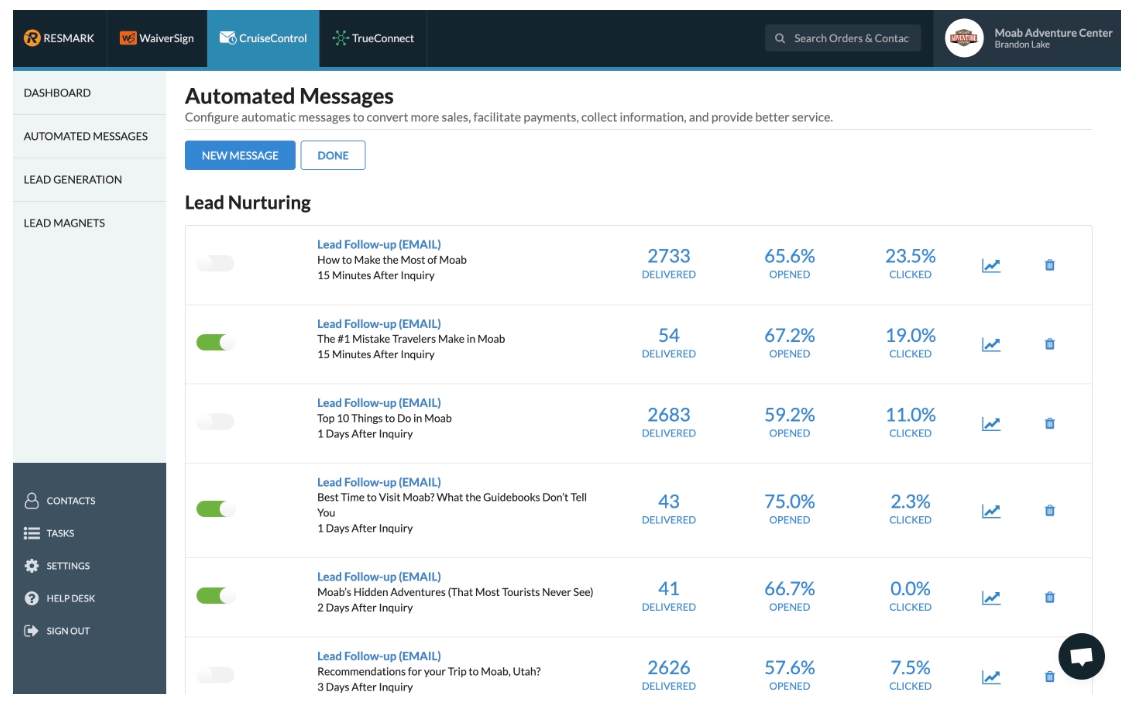
Automated lead nurture sequences follow up and convert prospects into bookings. Getting someone's email is the beginning, not the end.
60%+
Average open rate on automated lead nurture sequences
20%+
Average click-through rate
3x
Higher engagement vs standard broadcast emails
78.6%
Open rate on top email: "Top 10 Can't Miss Dinner Spots"
What a high-performing sequence looks like:
10 emails over a daily cadence in the first 10 days after sign-up
Mix of genuinely helpful content and soft tour promotion
Plain-text format often outperforms designed emails — feels personal, not promotional
Each email has one clear call to action
Non-bookers move into a long-term monthly nurture sequence
Email Marketing
Email is still one of the highest ROI marketing channels, period — and most tour operators are dramatically underusing it. Email marketing outside of referrals is consistently a top lead driver. You own the data, you control the message, and you're not at the mercy of any algorithm.
50%
Of marketers say email is their most impactful channel
30–36%
Average open rates from people who opted into your lead magnet or newsletter
Think of your email marketing in three distinct groups: Prospects (opted in but haven't booked yet), New Customers (just booked — keep them engaged and excited), and Past Guests (bring them back and turn them into advocates). Each group deserves a different message.
Plain text emails often outperform designed ones — they feel personal, not promotional, and drive higher response
Understand your sales cycle: a single-day tour might need 2–3 emails; a multi-day expedition might need months of nurture
Send at minimum a monthly email to your full list — seasonal promotions, new trips, local destination guides
Segment by interest and trip type — relevant messaging dramatically increases open rates and bookings
Automate follow-ups for every new lead: availability checkers, inquiry forms, and lead magnet downloads all deserve a sequence
Use one clear call to action per email, and track clicks and bookings — not just opens
Go Deeper
Lead Nurturing & Ongoing Emails: How Tour Operators Turn Leads Into Bookings
Here's the reality: 98% of website visitors don't convert on their first visit. Remarketing lets you stay in front of people who already visited your site — people who already know who you are — without paying for cold traffic all over again. Most tour operators are missing this entirely.
Step one: install your tracking. Your Meta Pixel and Google Tag are small pieces of code that track what visitors do on your site. Without them, remarketing is impossible. Even if you're not running ads yet, install these now — so you're building your audience while you wait.
20–40%
Lower cost per acquisition vs cold audience campaigns
6–15x
Better return on ad spend vs cold audience campaigns
$5–10
Per day is enough to start — remarketing doesn't require a big budget
Don't remarket everyone — focus on high-intent visitors: people who viewed specific tour pages or started booking
Build separate audiences for tour page viewers, cart abandoners, lead magnet downloaders, and past guests
Show tour-specific ads based on the exact page they visited — relevance is what makes remarketing work
Messaging should reassure, handle objections, and use social proof — let your guests sell for you
Use layered messaging: reminder → social proof (guest testimonial video) → urgency/offer
Use frequency caps so you stay top of mind without being annoying — 3 times per week is a good starting point
Exclude guests who already booked to avoid wasted spend and confusion
Refresh creative every 30–45 days to avoid ad fatigue
Go Deeper
How Retargeting Ads Bring Tour Guests Back to Book
Now that you've seen everything that goes into the planning stage, it's time to take stock of where you are. Which of these do you have dialed in — and which ones are still costing you bookings you've already earned?
Website Conversion
My website clearly communicates what I offer, where, and who it's for — within 3 seconds
Every tour page shows price, duration, and key details without requiring scrolling
I'm using real photos and videos of actual guests — not stock imagery
Every page has one clear, prominent call to action
I have AI or live chat set up to answer questions instantly
Lead Capture
I have at least one lead magnet capturing emails from visitors who aren't ready to book
My lead magnet provides genuine value — a real planning resource, not just a discount
My lead magnet is prominently featured on my website with a clear opt-in
Follow Up
I have an automated email sequence that follows up with every new lead
I'm sending regular email campaigns to past guests and prospects
I have the Facebook Pixel and Google Tag installed on my website
I'm running retargeting ads for people who visited tour pages but didn't book
My messaging is consistent across email, social, and paid ads
Stage 03
Booking: How People Convert
This is where friction kills revenue. Someone is ready to book — they've done their research, they trust you, they want to go. Every unnecessary step, every moment of confusion, every mobile hiccup is costing you bookings you've already earned.
Core Question
How easy is it for someone to actually book right now?
67%
Of travelers will pay more if the experience aligns with their values
36%
Lower cart abandonment with a simple checkout progress bar
14%
Conversion lift from urgency phrases when used correctly
42%
More clicks when trust signals are near the Book Now button
Booking — Offline
Offline Booking
Document proven phone scripts for handling common pre-booking questions and objections
Train your team on urgency language: "We do have availability this weekend, but it fills up fast"
Follow up every phone inquiry with an email recap and a clear next step
Track offline bookings separately so you understand the full picture of your sales channels
Respond to every inquiry within 1 hour — response speed is one of the biggest drivers of conversion
Upsell
Train your team to offer one relevant add-on during every booking call
Frame upsells as recommendations: "Most guests doing this trip also add..."
Have a short list of 2–3 upsell options ready for every tour type
Booking — Online
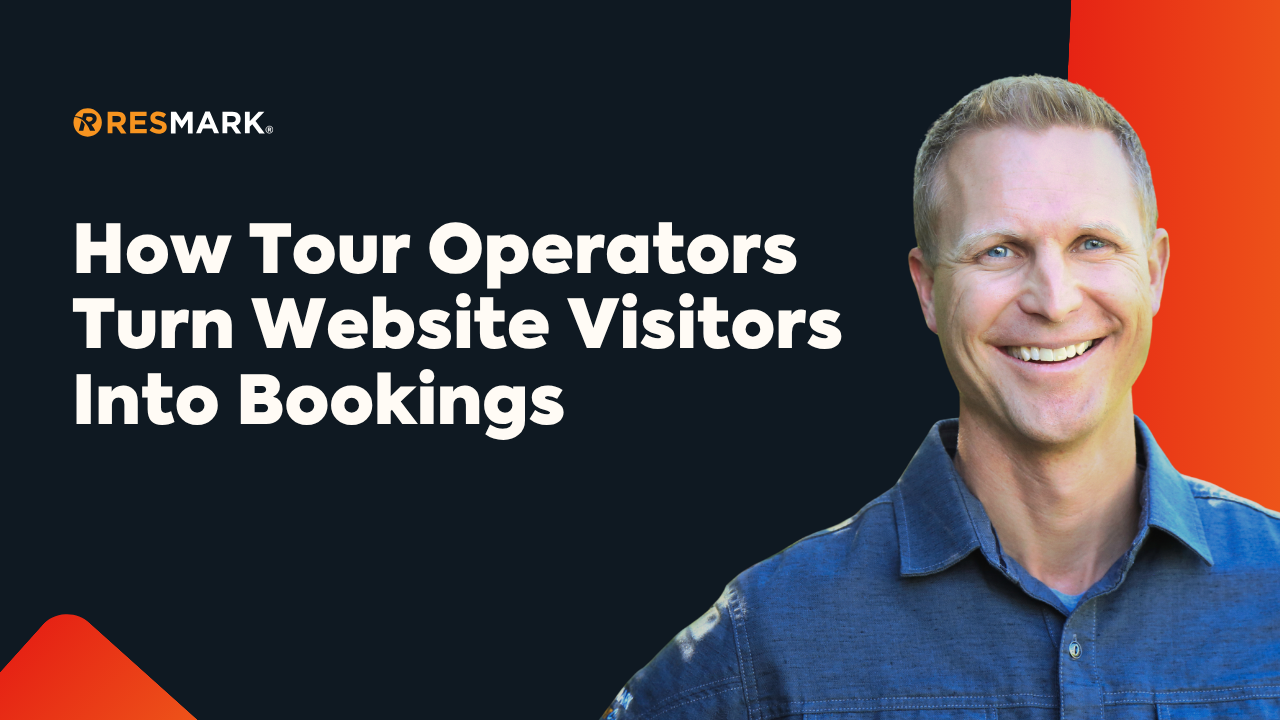
Free Webinar
How Tour Operators Turn Website Visitors Into Bookings
Watch the replay and learn the exact strategies top-performing operators use to convert more traffic into confirmed bookings.
Before a guest ever clicks Book Now, your tour copy and pricing have to do the selling. The words on your product pages should speak directly to your ideal customer — not to everyone. Generic descriptions ("a fun day on the river") convert like generic ads. Descriptions that sound like they were written for one specific person convert.
Your pricing presentation matters as much as the price itself. Anchoring, framing, and what's included shape whether your tour feels like a deal or a stretch — even when the dollar amount is identical.
Write for your ICP — name the trip type, the experience level, and the kind of guest it's built for ("first-timers welcome," "for serious paddlers," "family-friendly with ages 6+")
Lead with the outcome and emotion, not the itinerary — what will they feel, see, and remember?
Show what's included vs. what's extra so the price feels complete, not surprising
Anchor premium options against your most popular tour so guests can see the value step-up
Use guest language — pull phrases from your top reviews and bake them into your descriptions
Keep pricing consistent everywhere — tour page, booking flow, confirmation, and any partner listings
If you offer dynamic or seasonal pricing, explain why briefly — clarity prevents sticker shock
Test one tour page at a time: rewrite the headline and first paragraph, then watch conversion for 30 days
Product View
Product pages are designed for conversion with urgency triggers and risk reducers. Your tour pages are your best salespeople — make sure they're doing the job.
High-quality video and image gallery showing real guests on real trips
Price, duration, and key details visible without scrolling
Star ratings and review counts placed near the Book Now button
Cancellation policy clearly visible before they click to book
Urgency signals: "Only 4 spots remaining" or "Most popular trip this summer"
FAQ section addressing the top questions guests ask before booking
Online Booking
Your online checkout process needs to be fast, mobile-optimized, and built for your products. The best booking flows stay on your website, match your brand, and get guests from "I want this" to "booking confirmed" with as little friction as possible.
Stay on your website
Sending guests off to a third-party platform that looks nothing like your site creates doubt at the worst possible moment.
Show a progress bar
Guests want to know how close they are to done. A simple progress bar reduces abandonment by up to 36%.
Auto-fill & mobile optimize
Every field that requires typing on mobile is a drop-off point. Minimize required fields and enable auto-fill.
Reinforce trust at checkout
Don't stop showing reviews and guarantees once they click Book Now. Doubt peaks at checkout — counter it.
Step 1
DETAILS
Step 2
PAYMENT
Step 3
CONFIRMATION
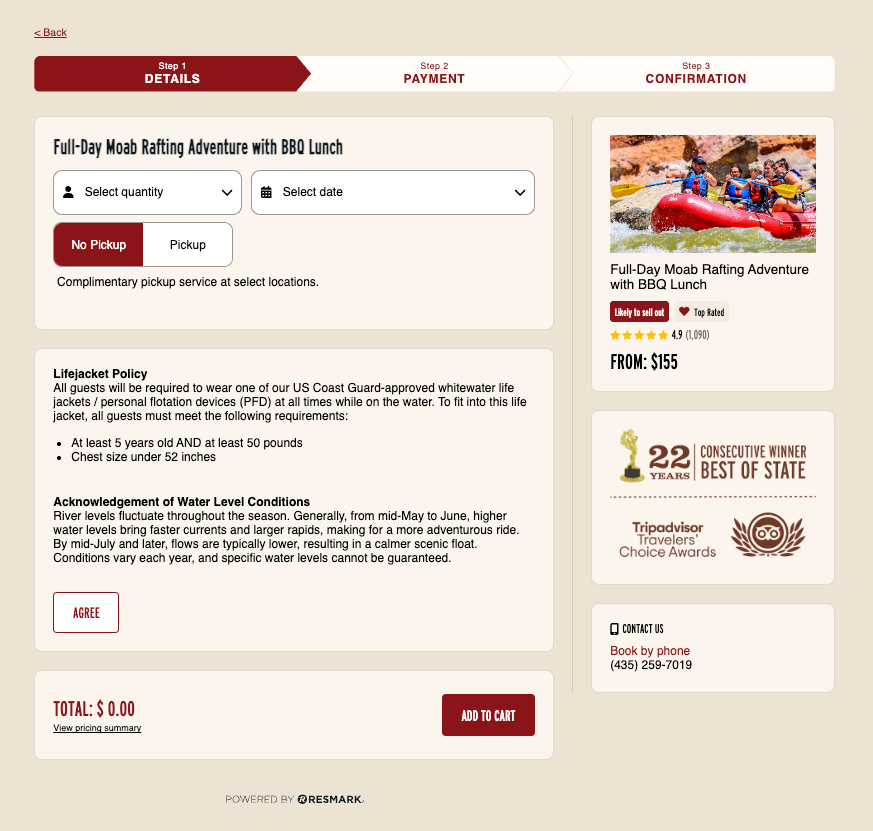
Full-Day Moab Rafting Adventure with BBQ Lunch
👤 1 Adult ▾
📅 April 10, 2026 ▾
No Pickup
Pickup
Begins: 8:00 AM at Moab Adventure Center Ends: 3:00 PM — Approximate end time
Lifejacket Policy
All guests required to wear US Coast Guard-approved PFDs at all times while on the water.
TOTAL: $155.00
ADD TO CART
Full-Day Moab Rafting Adventure with BBQ Lunch
Likely to sell out♥ Top Rated
★★★★½ 4.9 (1,090)
FROM: $155
22
Consecutive Winner Best of State
TripAdvisor Travelers' Choice Awards
✓ Step 1
DETAILS
Step 2
PAYMENT
Step 3
CONFIRMATION
Shopping Cart
Full-Day Moab Rafting Adventure with BBQ Lunch
Friday, April 10, 2026 · 8:00 AM to 3:00 PM · 1 Adult
$160.92
1
Contact Details
First Name
Last Name
Email
Phone
2
Terms and Policies
By confirming this booking, you agree to the following terms and policies.
▶ Cancellation, Payment and Refund Policies
▶ Minimum Trip Capacity
▶ Guest Responsibilities
We'll hold your spot for 14:48 minutes.
Order Total $160.92
All taxes and fees included
★★★★½ 4.9 (1,090)
✓ Best Price. Guaranteed.
Book directly with Moab Adventure Center for the best rates.
✓ Decades of Expertise
We've been honing the perfect adventures since 1961.
✓ Utah's Best Adventures
Voted best adventure company for 22 consecutive years.
Present one recommendation immediately after confirmation — don't interrupt the booking flow itself
Include reviews on the upsell offer to build confidence
Frame it with social proof: "Most guests who book this also add..."
Track average order value and test different offers over time
Booking Stage Checklist
You've done the work to get people to this point — don't lose them at the finish line. How many of these booking stage elements do you have working for you right now?
Offline Booking
My team has documented scripts for handling common pre-booking questions
I'm responding to every inquiry within 1 hour during business hours
My team knows how to offer a relevant upsell on every booking call
I'm tracking offline bookings separately so I understand my full channel mix
Descriptions & Pricing
My tour descriptions speak directly to my ideal customer profile
My copy leads with the experience and outcome, not just the itinerary
Pricing is clear, consistent, and shows what's included vs. extra
I've pulled language from real guest reviews into my product pages
Online Booking
My booking flow stays on my website and matches my brand visually
I can complete a booking on mobile in under 3 minutes without confusion
My checkout shows a progress bar so guests know how close they are to done
I'm displaying trust signals and reviews within the checkout flow
My tour pricing is clear and consistent from the tour page through to checkout
I have a post-booking upsell in place to increase average order value
I have AI or live chat capturing and answering leads after hours
Stage 04
Experiencing: The Actual Tour or Activity
This is your product — and it directly fuels your reviews, referrals, and repeat business. The experience stage begins the moment someone books and doesn't end until they've shared how it went.
Core Question
Does the experience live up to — or exceed — what you sold?
70%
Of guest satisfaction influenced before the trip even begins
3x
More likely to get a 5-star review when guests are prepared before arrival
30–50%
Reduction in support calls from automated pre-arrival messages
27%
Increase in return visits from personalized post-purchase communications
Optimized Confirmation
Include a personal video welcome from the lead guide or owner
Confirm all key details clearly: date, time, meeting location, what to expect
Add a "you're going to love this" moment — a highlight reel, a guest story, a stunning image
Set expectations around what to bring, difficulty level, and any prep they should do
Post-Purchase Messages
Insider tips and local restaurant recommendations in the days immediately after booking
What makes this trip special — help guests feel great about their decision
Payment notifications sent automatically — guests aren't left wondering
Any relevant destination or condition updates as the trip approaches
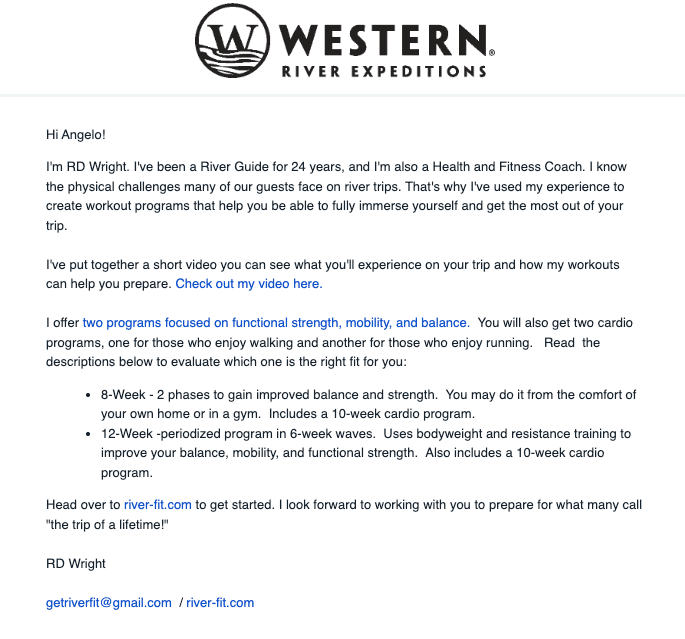
This pre-trip prep email was sent to get Nikki's (Marketing Director at Resmark) father physically ready for an upcoming expedition.
Real-Time Notifications
Between booking and trip day, guests have questions, balances to pay, and details that change. Real-time email and SMS notifications keep them informed without forcing them to call or dig through their inbox — and let them act on payments and updates in seconds, from their phone.
This is one of the most underused parts of the guest journey. Operators who automate it see fewer support calls, faster balance payments, and dramatically higher guest confidence heading into the trip.
Send automated payment reminders with a one-tap pay link — no logging in, no hunting for an invoice
Confirm every payment in real time so guests know it went through and don't double-pay
Use SMS for time-sensitive updates: weather changes, meeting location adjustments, water levels, road conditions
Keep email for richer content: itinerary changes, packing updates, anything that benefits from formatting
Let guests update their own party details (names, ages, dietary needs) through a secure link rather than email back-and-forth
Send a same-day "we're ready for you" message with weather, parking, and meeting point — even if nothing changed
Brand every message — "Your tour" not "Your booking #48291" — so it feels like a guide texting, not a system
Respect frequency — guests should hear from you when something matters, not constantly
Pre-Trip Messages
1
1–2 weeks out
Packing list, what to wear, meeting location, weather notes, and "what to expect" content. This alone reduces support calls by 30–50%.
2
Day before
A short, warm message with final logistics, any last-minute weather or conditions notes, and genuine excitement.
3
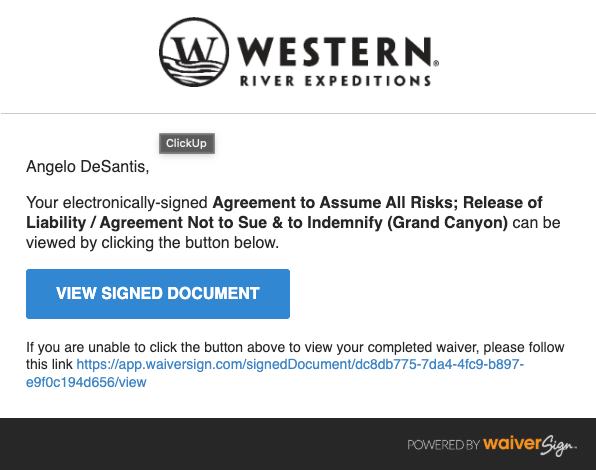
Waiver completion reminder
Automated waiver reminders ensure paperwork is done before arrival — no delays, no awkward check-in moments.
Trip Experience
Guide quality is your single biggest variable — invest in training, culture, and retention
Small "surprise and delight" moments are disproportionately memorable — standardize your best ones
The check-in process sets the tone — make it smooth, personal, and welcoming
Equipment, safety, and logistics need to be consistently flawless — these are table stakes
Capture content during trips — it fuels your Dreaming and Sharing stages
Experiencing Stage Checklist
We know most tour operators are delivering an amazing experience on the trail or on the water — but the experience stage goes far beyond the tour itself. How many of these do you have in place?
Confirmation & Post-Purchase
My booking confirmation includes more than just logistics — it builds excitement
I have an automated post-purchase email sequence that runs in the days after booking
Payment and waiver notifications are automated — no manual follow-up required
Real-Time Notifications
Guests can pay balances with a one-tap link from email or SMS
I use SMS for time-sensitive updates (weather, meeting location, conditions)
Guests can update their own party details through a secure link
Every payment is confirmed in real time so guests never wonder if it went through
Pre-Trip
I send a pre-trip reminder 1–2 weeks out with packing list, meeting location, and what to expect
I send a day-before reminder with any last-minute details
Waivers are completed before guests arrive — no delays at check-in
Trip Experience
My guides are trained, consistent, and delivering a standardized excellent experience
I have documented "surprise and delight" moments built into every trip
My check-in process is smooth, personal, and sets a positive tone immediately
I'm actively capturing content during trips to fuel my marketing
Stage 05
Sharing: What Happens After the Experience
This is your growth multiplier — and most operators underuse it badly. Reviews, referrals, user-generated content, and repeat bookings don't happen by accident. They happen because you have a system to activate them.
Core Question
Are your customers turning into your marketing engine?
93%
Of travelers read reviews before booking
1.7x
Higher local search ranking for businesses replying to 100% of reviews
3x
More reviews with an automated post-trip sequence
28%
Boost in social conversions from user-generated content
Guest Review Sequence
1
SMS within 24 hours
Short, personal, direct link to Google. One ask, one link. Keep it warm and human — not automated-sounding.
2
Email at 48 hours
A thank-you email with a helpful resource (local dining guide, next trip discount) and multiple review channel options.
3
Final reminder at 7 days
A gentle nudge for those who haven't reviewed yet. Remind them why their review helps other families find this experience.
Review Monitoring & Reply
"When I see a one-star review, I look at how the company responded. If they handled it well, I trust them more than a business with only perfect reviews."
— Corey Jay, Marketing Director at Zebulon LLC
Respond to 100% of reviews — businesses that do rank 1.7x higher in local search
Responding to negative reviews increases advocacy by 70%
Use a single dashboard to aggregate reviews from Google, TripAdvisor, and other sources
Use AI as a starting point for responses — but always add a human touch before posting
Create a dedicated reviews page on your website that aggregates all sources
Post-Trip Message Sequence
Send a post-trip follow-up with photos or a highlight from their trip if you captured it
Include a "bring a friend" referral offer
Add guests to a long-term nurture sequence with seasonal inspiration and exclusive offers
Create a repeat booking campaign — past guests convert at significantly higher rates than cold traffic
Segment your list by trip type for more relevant follow-up content
Merchandise
82% of travelers say souvenirs increase their emotional connection to a brand. Well-designed merchandise gives guests something tangible to take home. Use print-on-demand fulfillment for zero inventory risk.
5–15%
Additional revenue from merchandise
17–25%
Conversion rate in the travel and experience sector
82%
Of travelers say souvenirs increase brand connection
User-Generated Content
1
Ask permission during the trip
If you see a guest taking great photos or video, ask if they'd be willing to share. Most people say yes when asked directly.
2
Incentivize guides to capture content
Western River Expeditions offers $20 per piece of content submitted by guides. One video got 1.5 million views.
3
Run an annual photo contest
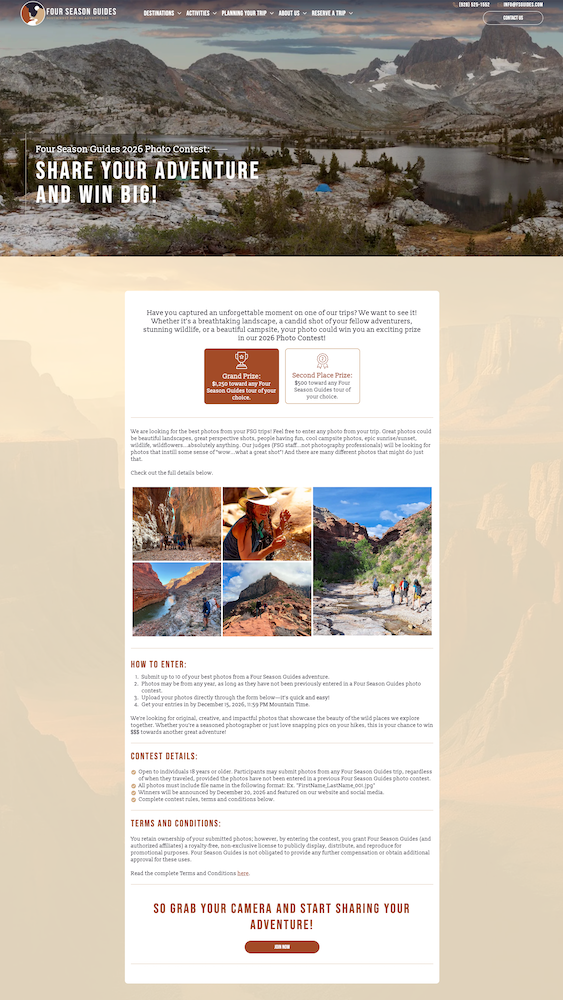
Four Season Guides runs a yearly photo contest — $1,250 first prize, $500 second — generating hundreds of authentic guest images all year.
Guest photos and videos become social posts, website galleries, email headers, and ad creatives. One great piece of content fuels a dozen marketing touchpoints.
Go Deeper: Podcast Episodes
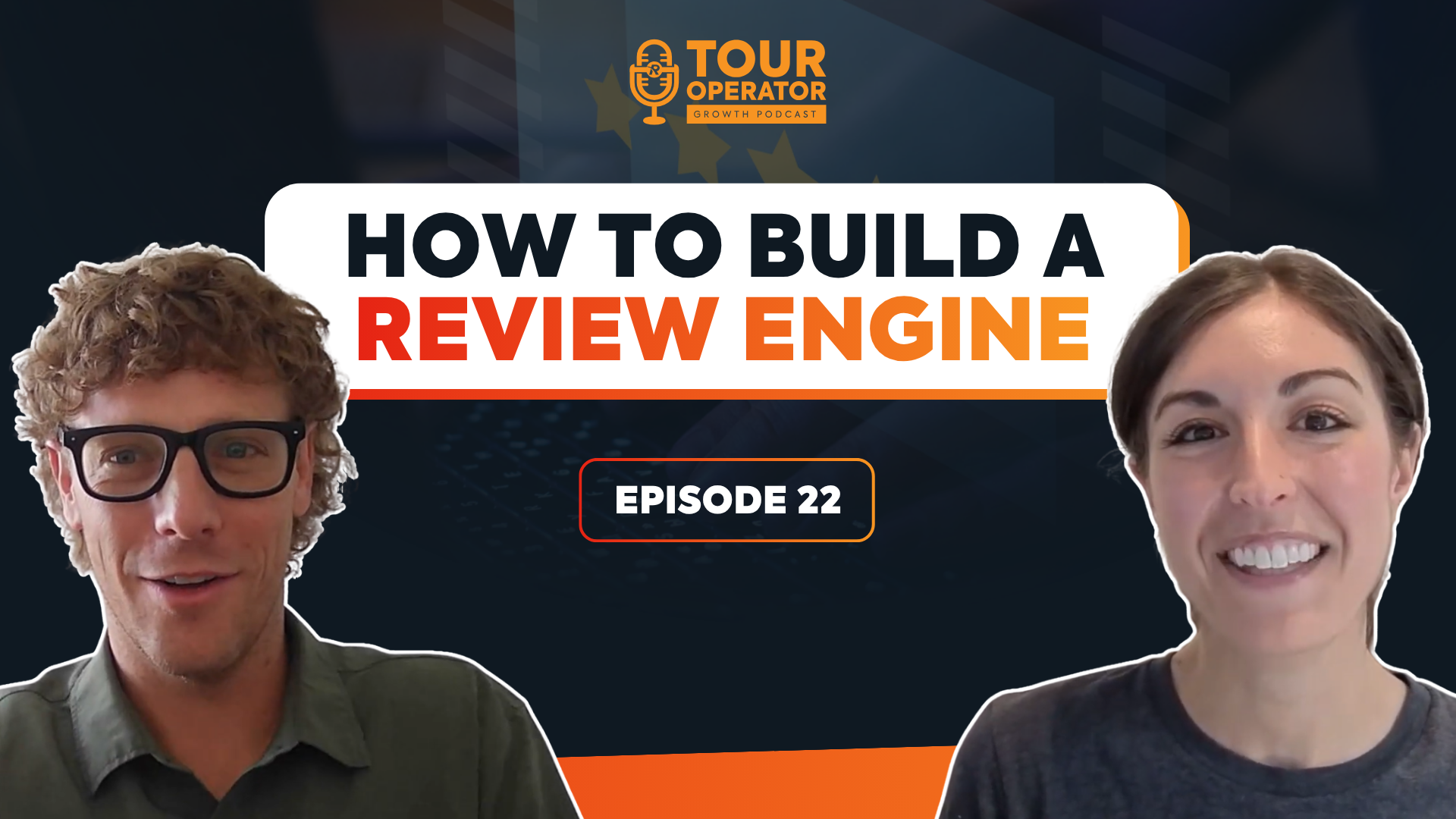
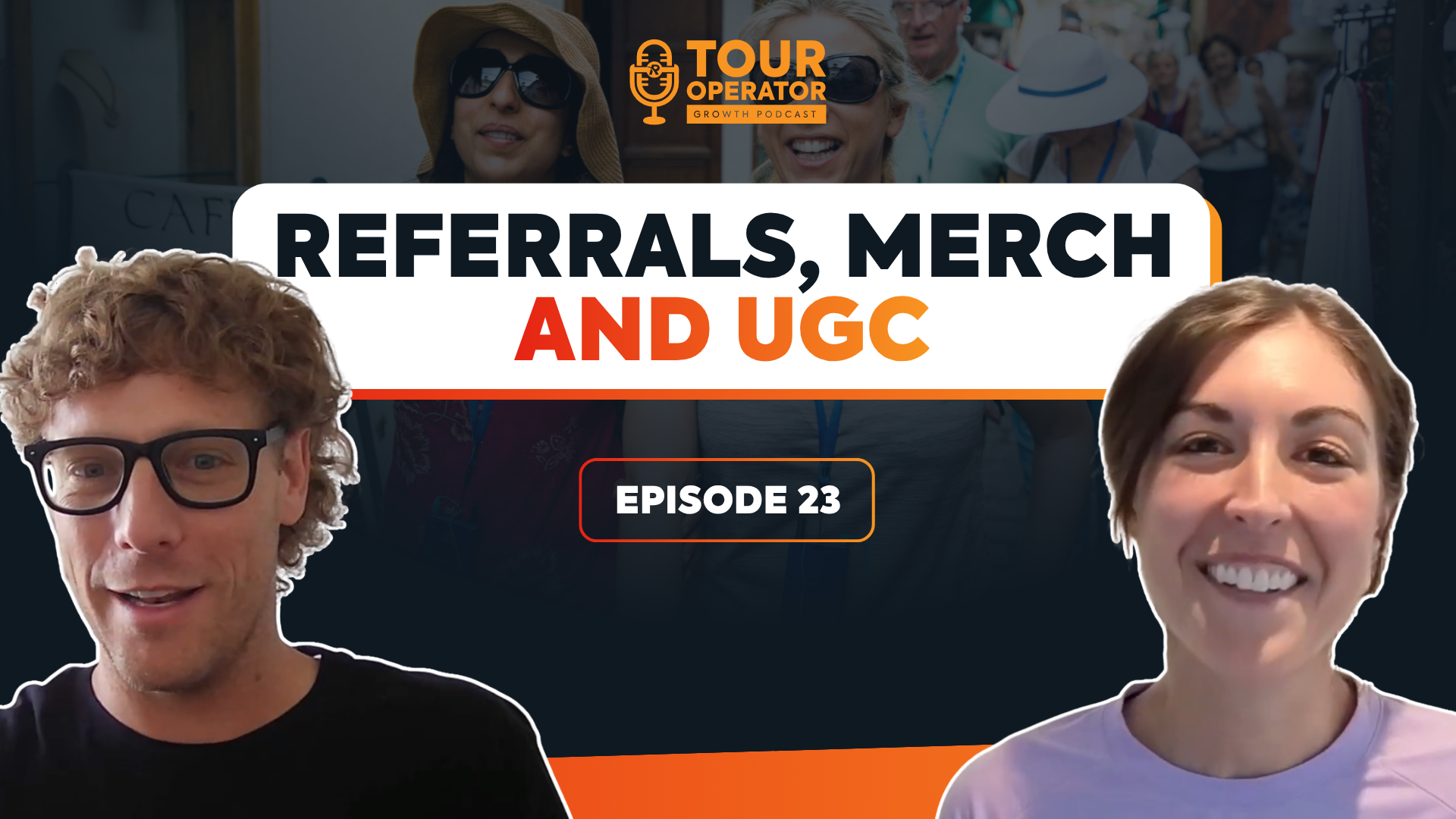
We dedicated a two-part podcast series to the Sharing stage — building a review engine your guests actually want to use, then turning happy guests into repeat bookings, referrals, merch buyers, and content creators.
Your guests just had an incredible experience — now let's make sure that experience keeps working for you. Reviews, referrals, and content don't happen automatically. Which of these systems do you have in place to turn every guest into your best marketer?
Reviews
I have an automated post-trip review sequence that goes out within 24–48 hours
My review request links directly to the Google review entry — not just my profile
I'm responding to 100% of my reviews, positive and negative
I have a dedicated reviews page on my website aggregating all sources
Post-Trip & UGC
I have a post-trip email sequence that nurtures past guests toward a return booking
I have a referral program or "bring a friend" offer in place
I have a system for collecting photos and videos from guides during trips
I'm repurposing guest content across social media, email, and my website
Merchandise
I have at least one branded merchandise product available for guests to purchase
I'm offering merchandise at checkout or in my post-trip sequence
I'm using print-on-demand fulfillment so there's zero inventory risk
The Full Picture
Putting It All Together
The Resmark Growth Engine isn't five separate strategies — it's one connected system. Every stage feeds the next, and the operators seeing the most growth are the ones who've built all five working in sync.
The operators winning right now aren't doing everything at once — they're building each stage deliberately, measuring what works, and compounding their results over time. Pick your weakest stage and start there.
What's Next
Your Growth Engine Starts Here
You've just walked through the same framework that's been used to grow a $15M+ tour operation and hundreds of businesses like yours. The operators winning right now aren't doing everything at once — they're building each stage deliberately, measuring what works, and compounding their results over time.
Take the Growth Assessment
Get your personalized Growth Engine Health Score across all 5 stages. Free, instant, and specific to your business.